Ask a learning and development (L&D) leader in life sciences what their organization spends on learning technology and the answers vary more than most expect.
Some know the number cold; they own the budget or they’ve made it their business to find out. Others aren’t as sure; not because they aren’t paying attention, but because the budget for it comes from outside of their department and isn’t within their purview.
 In fact, 19% of heads of commercial L&D cannot report their total learning technology spend (Figure 1). That number is more than double among high performers.
These findings come from the final installment of the three-part Annual State of L&D research series, published by TGaS Advisors in partnership with LTEN. Overall, 36 commercial L&D functions across life sciences participated.
The focus: how organizations manage, fund and govern their learning technology stack, the collection of systems, tools and platforms that support commercial L&D programs.
 Through the analysis, TGaS identified what separates high-performing L&D functions from the rest. In this research, one in three L&D functions qualified as high performers based on four criteria related to how:
- Learning technology connects to business goals.
- Tech systems are integrated and share data.
- The commercial organization uses the learning solutions created.
- The L&D function can adapt when things change.
From Drift to Drive
High-performing L&D functions stand out in predictable ways. In the research, about one in three organizations qualified as high performers based on how well their learning technology supports and adapts to business needs.
While the full criteria span strategy, integration, adoption and adaptability, one theme consistently separated these high performers from the rest: they have visibility into what their technology costs and why.
Budget visibility isn’t about spreadsheets, it’s about connection. When L&D understands the cost and purpose behind each tool, it becomes easier to link the tech stack to business goals and make intentional decisions. That visibility fuels what the research describes as the difference between drift and drive.
- Drift happens when tools renew automatically, new platforms get added without anyone knowing what’s already in place and decisions rely on assumptions rather than data. It isn’t a leadership failure; it’s simply what happens when the operational picture is fragmented or unclear.
- Drive, by contrast, shows up when L&D has a clear view of what’s in the stack and what it costs. High performers demonstrate drive by using that information to make purposeful choices about what stays, what goes and what gets added.
Where the Budget Sits Today
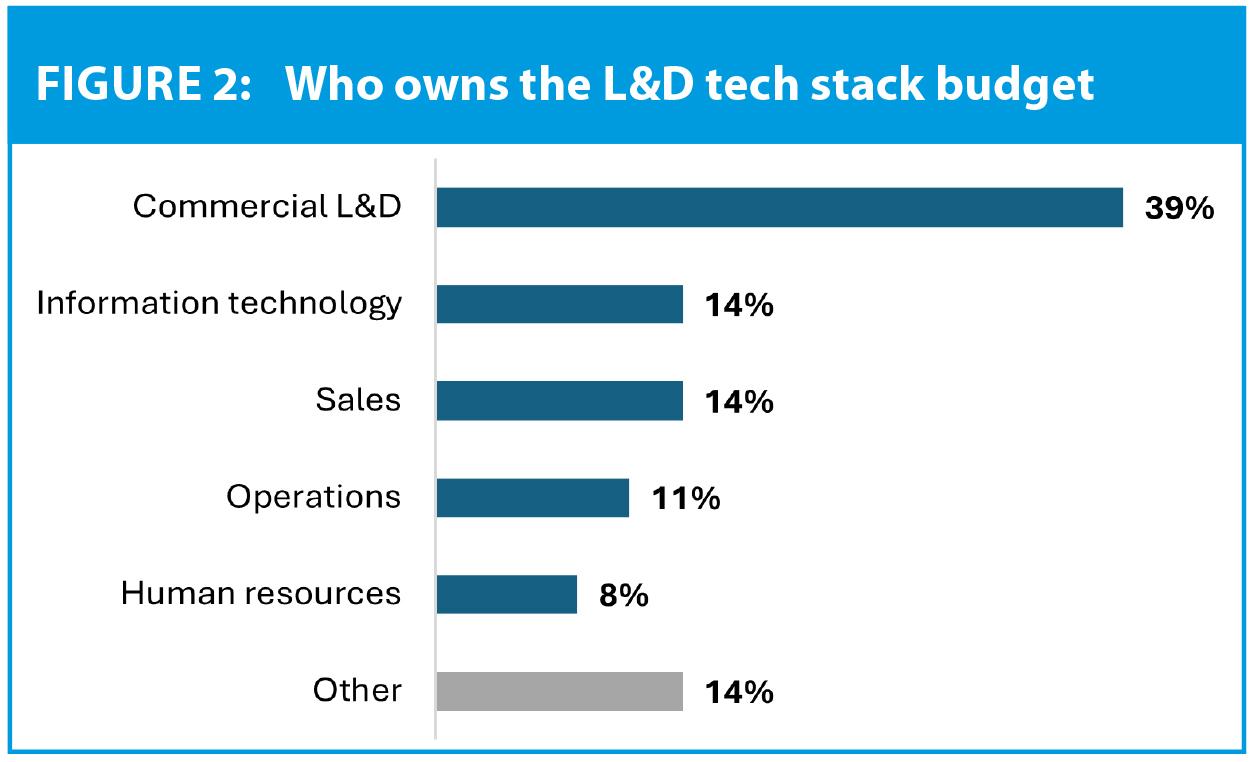
Among commercial L&D functions, 39% own the budget that funds their learning technology (Figure 2). For those organizations, L&D has a direct line between the tools they’re responsible for and the money behind them.
For everyone else, it’s scattered.
When ownership is fragmented, the budget isn’t invisible because someone is hiding it. It’s invisible because it belongs to multiple functions and no single person has the full picture. Some organizations described it as a mix, where each business unit contributes to a centralized team.
Others noted it depends on the system and how widely it’s used. That fragmentation is an organizational reality, and it has consequences.
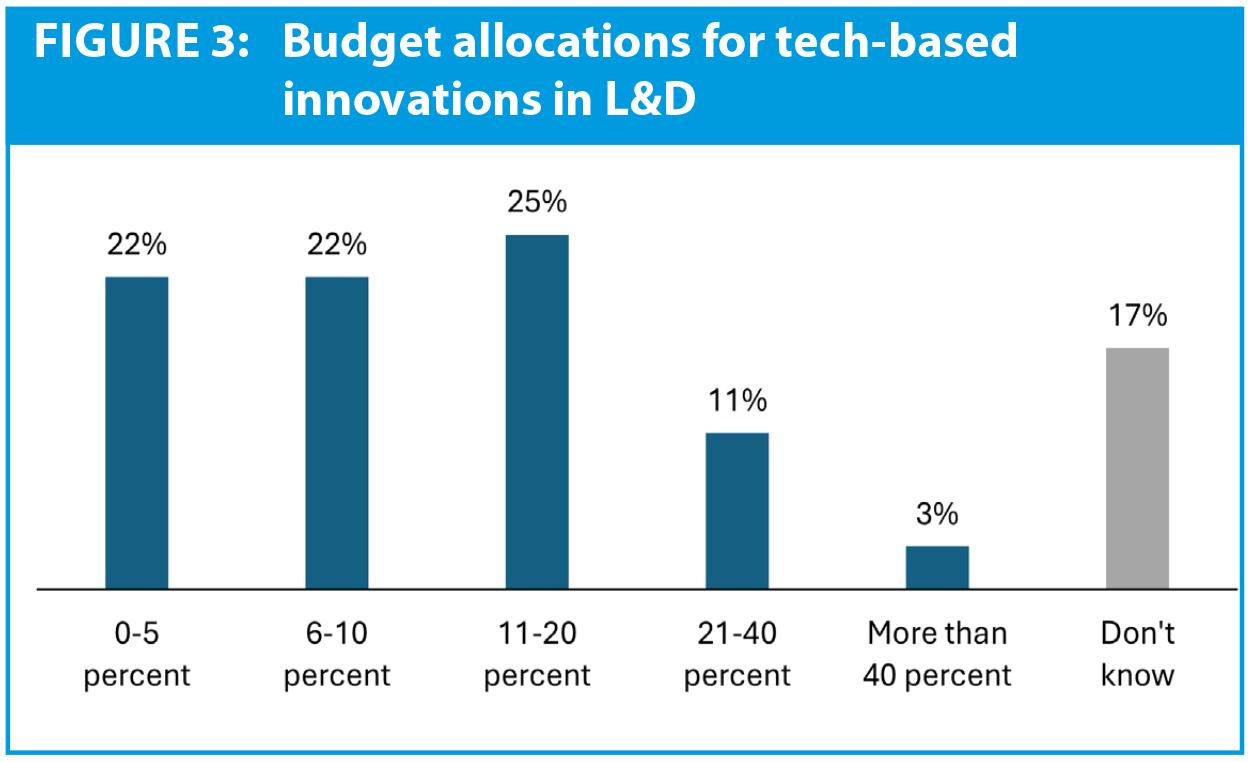
Without visibility into the budget behind the technology, every other conversation gets harder. Innovation stays modest: 17% of respondents don’t know what percentage of their budget goes toward piloting new tools and capabilities (Figure 3).
Without that visibility, evaluating whether innovation spending is working becomes guesswork, and making the case for more of it or less of it becomes harder still. That’s major drift.
The good news: closing that visibility gap doesn’t require owning the budget. It starts with information.
Three Moves to Get There
These three moves can put any L&D professional in a stronger position regardless of where the budget sits in the organization, and they’re a practical pathway to becoming the kind of trusted advisor every L&D function needs.
Move 1: Build a Tech Inventory
Catalog every system, tool and platform in the learning technology stack, both what the team uses and what learners interact with. Start with the essentials: the supplier, what it does, who uses it, the annual cost and when the contract renews.
From there, fields like license type, number of licenses, budget owner, internal owner, supplier contact and support model round out the picture and make the inventory a working document, not just a list.
The inventory tells L&D what’s in the stack. The usage audit tells whether it’s working.
Move 2: Run a Usage Audit
With that established inventory, go back and for each tool, look at:
- Who’s using it.
- How often.
- Which departments.
- For what.
Is it used daily by the whole commercial organization or quarterly by one team? Is usage cyclical around launches or consistent year-round? Is it the primary tool for a critical function or a backup nobody remembers subscribing to?
This is where redundancy, underutilization and real value become visible. This visibility drives discussions and puts L&D at the table with clear insights to share.
Move 3: Show Up With the Information
The first two moves produce something that most L&D leaders don’t walk into meetings with: specifics. That changes what’s possible in every conversation that touches learning technology.
Consider the following use cases:
- A renewal is coming up and L&D can show that a software development tool has 12 licenses and three people using it only quarterly.
- A supplier pitches a new tool that leadership wants and L&D can compare it against what’s already in the stack, what it costs and what’s actually producing value.
- A budget owner wants to cut costs and L&D can point to where spend is redundant and where it’s earning its keep.
None of that requires owning the budget. It requires knowing enough to be the person in the room with the information and helping to guide strategic and operational decisions.
The Bottom Line
Some L&D leaders will read this and recognize work they’re already doing. That’s drive.
Others will see a gap they hadn’t framed this way before. That’s where drive starts.