 In January and February of this year, LTEN members and professionals from many other organizations participated in GROWLE — Global Research on Workplace Learning Evaluation. The research project was designed to capture how learning and development (L&D) professionals around the world actually approach evaluation.
It asked practitioners what they measure, which frameworks they use, what benefits they see, what obstacles they face, what their senior leaders are telling them and how they are using artificial intelligence (AI). LTEN was a platinum research partner, helping recruit life sciences respondents into the pool.
The GROWLE 2026 Research report on learning evaluation was recently released, and some of what it tells us should be a wake-up call for the life sciences L&D community.
For instance, we know about our over-reliance on learner surveys, but the research reveals that 54% of organizations are using three or more problematic survey tactics. Also, 24% are using five or more problematic learner-survey practices.
Even worse, the No. 1 way we measure learning impact on work performance and results is learner surveys — a tool totally unsuited to the task.
There is good news in the research, too. A clear set of benefits emerges from learning evaluation. (Figure 1)
We know what obstacles we face in doing good evaluation. Strong evaluation methods are more common than our self-image suggests.
A third of us measure scenario-based decision making on most programs, 29% measure task performance during learning and 21% measure learning transfer — a genuinely difficult thing to measure.
This article will highlight other key takeaways from the research that will help you in your learning evaluation efforts.
The Learner Survey Surprise
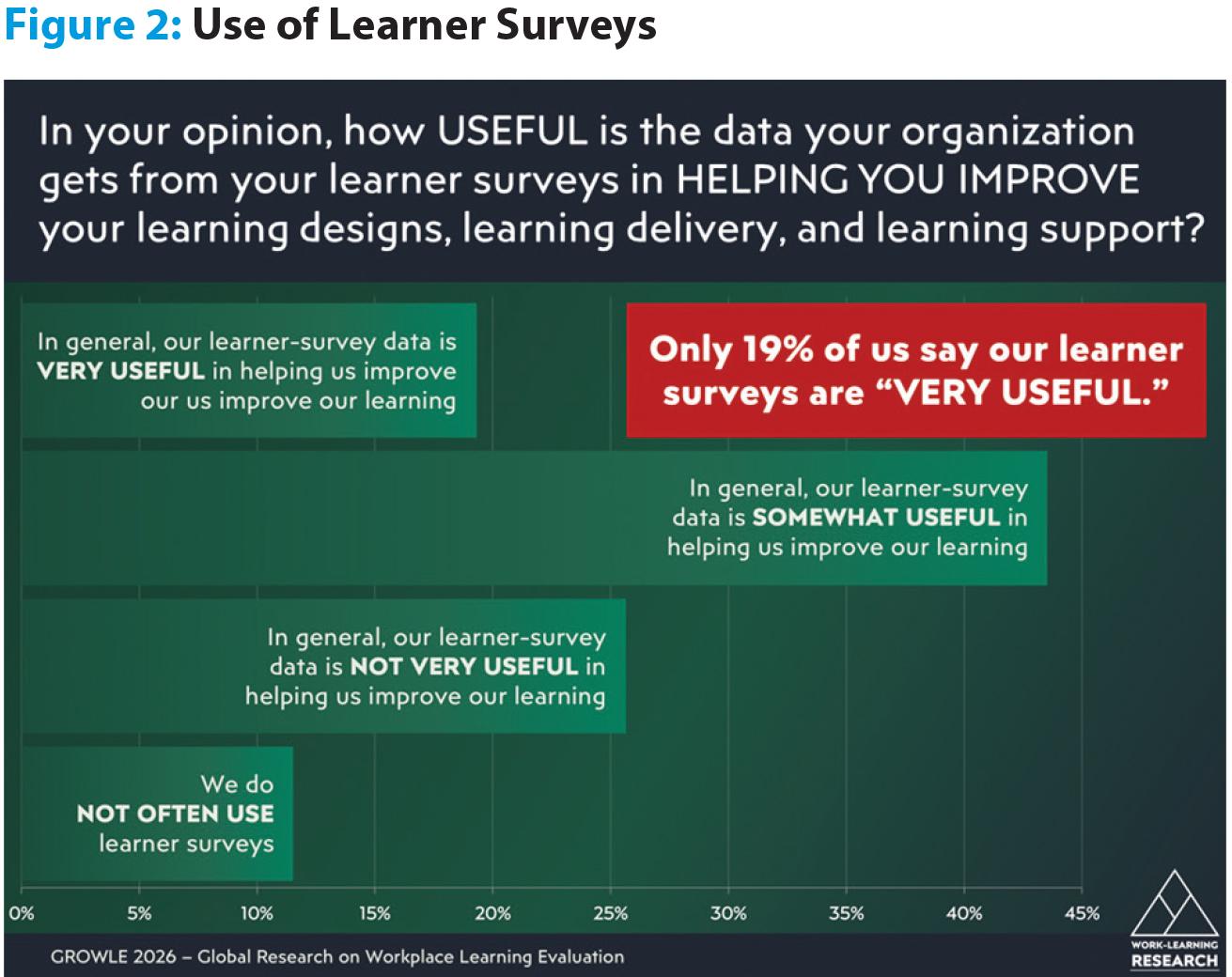
If there is a single finding that should reshape conversations in your hallways and team meetings, it is this: 73% of organizations use learner surveys on more than half of their programs, but only 19% of practitioners describe their survey data as “very useful.” Another 68% describe it as only somewhat useful or not very useful at all. (Figure 2)
The gap between our reliance on learner surveys and our skepticism in their value is not a mystery when we look at how we design surveys. When 10 problematic survey practices were combined into a single index, the results revealed that 54% of organizations used three or more of them regularly, and 24% used five or more.
These problematic practices include Likert-like items, satisfaction and course-reputation questions, numeric scales and Net Promoter Scores. Two meta-analyses spanning more than 150 studies have found that traditional smile sheets correlate with learning at r=.09 — essentially zero.
A finding life sciences L&D folks should pay particular attention to is this one: Half of respondents said their organization measures learning impact by asking learners to complete surveys. In a launch-driven environment, where the question “Is the field actually ready?” carries millions of dollars and patient outcomes behind it, leaning on a learner’s self-reported impression as your impact measure is exactly the wrong move.
The most experienced practitioners (21+ years) already know this — they report relying on surveys for impact measurement at roughly 20 points below their mid-career colleagues, and the pattern holds across every role.
The good news is that better methods exist, and stronger measurement is more common than our self-image suggests. A third of L&D professionals reported that their organizations measure scenario-based decision making on more than half of their programs — a tier of measurement well-suited to the detailing, objection handling and clinical conversations life-science learners must execute. Also, 29% measure task performance during learning and 21% measure learning transfer.
 The Senior Leadership Myth
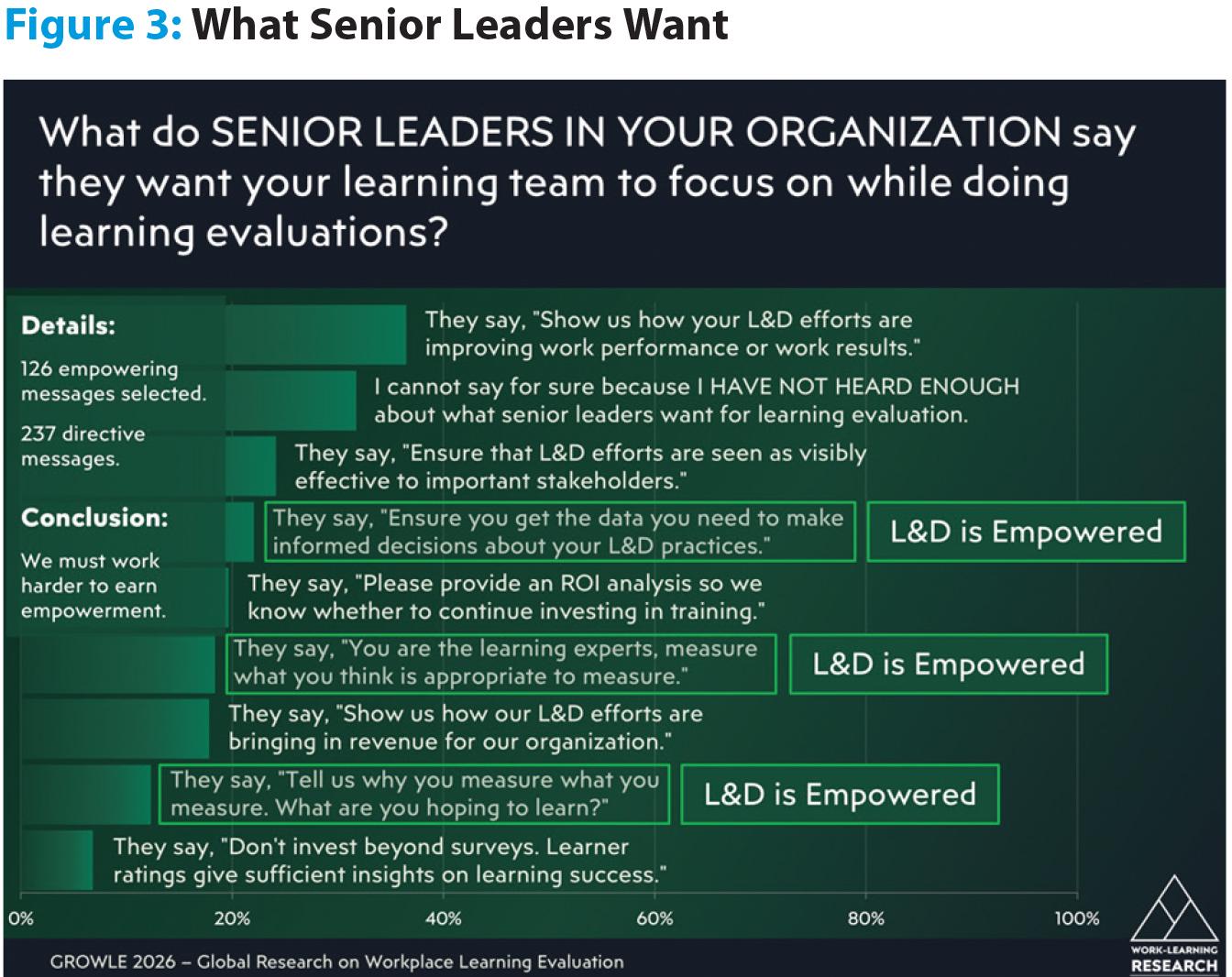
For years, life sciences L&D teams have been told that senior leaders demand return on investment (ROI), impact data and that we prove dollar value. The GROWLE data complicates that narrative. Among L&D professionals in mainstream organizations, 53% had not heard what their senior leaders expected for learning evaluation. Only 21% had heard any messages clearly. (Figure 3)
When practitioners did hear from senior leaders, the messages were a mix of directive and empowering.
Among the empowering messages were these three:
- “You are the learning experts, measure what you think is appropriate to measure.”
- “Ensure you get the data you need to make informed decisions about your L&D practices.”
- “Tell us why you measure what you measure. What are you hoping to learn?”
These messages convey a sense that senior leaders see us as capable professionals. More troubling, empowering messages were selected only 126 times against 237 directive ones. The implication is that empowerment is something we’ll have to earn — by building evaluation practices credible enough to warrant trust.
Why does this matter for life sciences? Because the assumption that senior leaders are demanding a particular evaluation approach — usually framed as ROI or financial impact — has shaped what many L&D teams have built.
The data suggests that fewer of us are getting clear marching orders than is commonly believed.
That means there is more room than we may have assumed to redesign evaluation around what actually answers the questions that matter.
 Gaining a Competitive Advantage
Here is where GROWLE gets actionable. Picture two L&D teams in similar life sciences organizations.
Team A continues using attendance metrics (86% of organizations measure these), traditional smile sheets (73% use surveys, often poorly designed) and knowledge checks (61% use these).
Team B keeps these things — they are useful starting points — but adds scenario-based decision-making questions for clinical and selling conversations, task-performance measurement during simulation-based training, post-launch transfer measurement on a few flagship programs and disciplined AI use to analyze open-ended learner comments and develop assessment items.
Team B will gain more insights from their evaluations and make better learning-design decisions. Their representatives will remember more, use more of what they learned and perform better in the field. Their medical-affairs and compliance colleagues will have actual evidence of capability rather than completion data.
Those are competitive advantages — for the organization, for the learners and for the L&D team itself.
The data also reveals where other competitive advantages may lie quietly.
AI dominates the field’s aspirational innovation list at nearly four times the rate it shows up in current practice. Some of that is genuine opportunity. Some is herd behavior. Less-crowded directions like multi-source evaluation, post-training follow-up, continuous measurement and experimental designs may be where real differentiation lives.
Turn Insight Into Action
The full GROWLE 2026 Research report is available free at WorkLearning.com/GROWLE/.
Read it, share it with your team and use it as a starting point for harder conversations about how your organization measures learning.
The teams that move now — on better surveys, on measuring decision-making and task performance, on disciplined AI use — will pull ahead of the ones still measuring attendance and calling smile sheets evaluation.
Quick Wins for Life Sciences Learning Teams
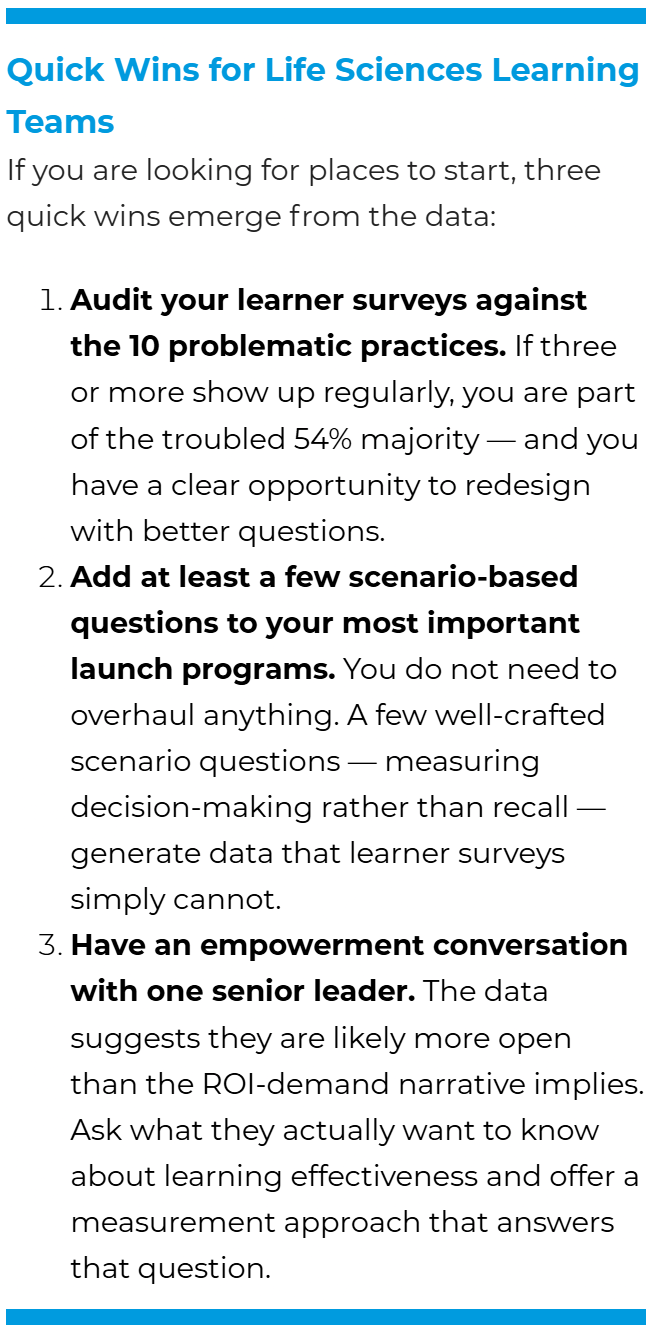
If you are looking for places to start, three quick wins emerge from the data:
-
Audit your learner surveys against the 10 problematic practices.
If three or more show up regularly, you are part of the troubled 54% majority — and you have a clear opportunity to redesign with better questions.
-
Add at least a few scenario-based questions to your most important launch programs.
You do not need to overhaul anything. A few well-crafted scenario questions — measuring decision-making rather than recall — generate data that learner surveys simply cannot.
-
Have an empowerment conversation with one senior leader.
The data suggests they are likely more open than the ROI-demand narrative implies. Ask what they actually want to know about learning effectiveness and offer a measurement approach that answers that question.